How Many Gallons Per Hour For A 30,000 Btu Infrared Heater?
Your 30,000 BTU infrared heater is powerful. BTU stands for British Thermal Unit. It’s a way to measure heat.
More BTUs mean more heat. A 30,000 BTU heater puts out a lot of warmth. But this heat comes from burning fuel.
The amount of fuel it burns depends on the type of fuel and how hard it’s working.
Different heaters use different fuels. Common ones are propane and kerosene. Each fuel burns a bit differently.
They also have different energy amounts in each gallon. So, the number of gallons per hour (GPH) can change. It’s not a single, fixed number for all 30,000 BTU heaters.
We need to look at the specifics.
How Much Fuel Does a 30,000 BTU Heater Use Per Hour?
For a 30,000 BTU heater, we can make a good guess about fuel use. This is an estimate. It helps you understand what to expect.
Let’s look at the two most common fuels: propane and kerosene.
Propane Fuel Consumption
Propane is very popular for portable heaters. A 30,000 BTU propane heater uses about 1.3 gallons of propane per hour. This is when it’s running at full power.
This number is an average. It can change based on the specific heater model. It also changes with the actual gas pressure and temperature.
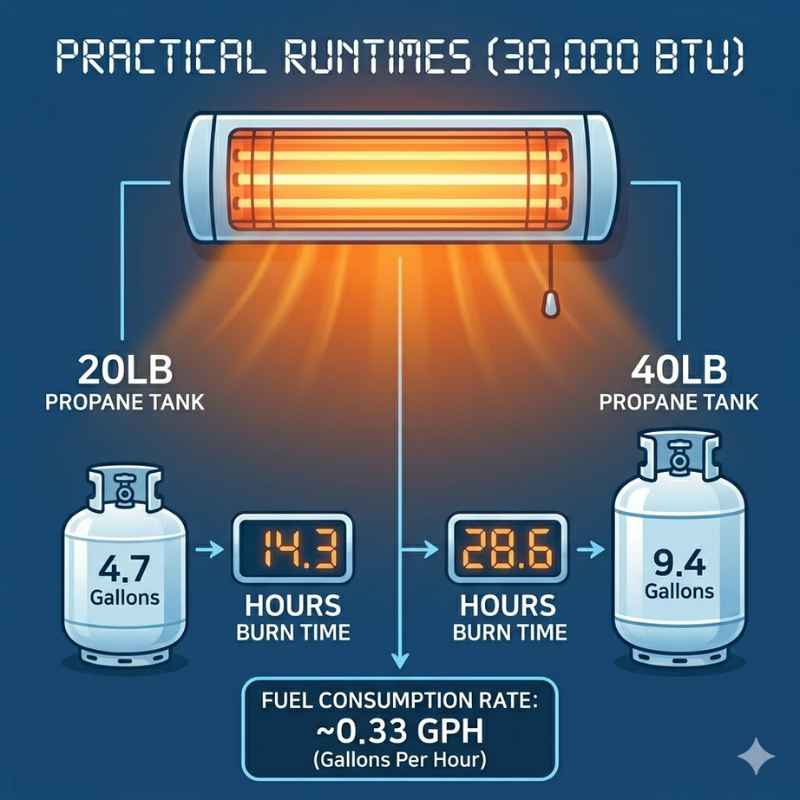
Think about a standard 20-pound propane tank. This is the common size for grills. It holds about 4.7 gallons of propane.
If your heater uses 1.3 GPH, that tank would last for roughly 3.6 hours. That’s at full blast. If you turn the heat down, it will last longer.
Understanding this helps you know when to swap tanks.
Kerosene Fuel Consumption
Kerosene heaters are also common. They often have a slightly different burn rate. A 30,000 BTU kerosene heater might use around 0.2 to 0.25 gallons of kerosene per hour.
Again, this is at full power. Kerosene has more energy per gallon than propane.
This means a gallon of kerosene can produce more heat. So, even though the number of gallons looks small, it’s putting out a lot of warmth. A 1-gallon kerosene can would last about 4 to 5 hours if the heater runs nonstop.
Many kerosene heaters have adjustable settings. This lets you lower the fuel use.
Fuel Use Quick Facts
Propane (30,000 BTU): About 1.3 gallons per hour (GPH) at full power.
Kerosene (30,000 BTU): About 0.2 to 0.25 gallons per hour (GPH) at full power.
These are estimates. Always check your heater’s manual for exact figures.
What Affects Fuel Consumption?
The numbers above are for when the heater is running at its highest setting. But most of the time, your heater isn’t on high. Several things can change how much fuel it actually uses.
It’s good to know these factors.
One big factor is the thermostat setting. Many modern heaters have thermostats. You set a desired temperature.
The heater then turns on and off to maintain that warmth. When it’s off, it uses no fuel. So, if your space is already warm or well-insulated, the heater won’t run as much.
This saves a lot of fuel.
The outside temperature also plays a role. On a very cold day, your heater will need to work harder. It will run for longer periods to keep the space warm.
On a milder day, it won’t need to run as much. This is true even if you have the same thermostat setting.
Insulation is super important. A well-insulated garage or workshop will keep heat in. Less heat escapes.
This means the heater doesn’t have to work as hard. A leaky, uninsulated space will lose heat quickly. The heater will run much more often.
I’ve seen this in my own garage. I added some insulation, and my propane tank lasted way longer.
The size of the space you are heating matters. A 30,000 BTU heater is designed for a certain area. If you try to heat a much larger space, the heater will struggle.
It will run constantly. This uses more fuel. If you are heating a smaller space, it will cycle on and off more.
This saves fuel.
The specific heater model is another point. Even within the 30,000 BTU range, different brands and models have slight variations. Some are designed to be more efficient.
Others might have simpler designs. Always check the owner’s manual. It will have the most accurate information for your unit.
Finally, altitude can sometimes play a part. At higher altitudes, engines and burners might not get enough oxygen. This can make them less efficient.
For most home use in typical areas, this isn’t a big concern. But it’s something to be aware of if you live very high up.
Real-World Scenarios and Fuel Use
Let’s imagine a few situations to see how fuel use can vary. This makes it more real.
Scenario 1: The Weekend Warrior in the Garage
John uses his 30,000 BTU propane heater in his garage on Saturdays. He’s working on his car. The garage is reasonably insulated.
He sets the thermostat to 65°F. The outside temperature is about 40°F. He works for about 4 hours.
The heater cycles on and off. He might use about 2 gallons of propane. This is less than running it at full blast for 4 hours.
Scenario 2: The Workshop on a Cold Night
Maria is using her 30,000 BTU kerosene heater in her uninsulated pole barn. She needs to finish a woodworking project. It’s 20°F outside.
She sets the heater to keep it warm enough to work, maybe 55°F. Because the barn isn’t insulated, the heat escapes fast. The heater runs almost non-stop.
She might use close to 1 gallon of kerosene over a 4-hour period. This is much closer to its maximum GPH.
Heating Cost Example (Estimate)
Let’s say propane costs $3.00 per gallon.
At 1.3 GPH, a full-power hour costs: 1.3 GPH * $3.00/gallon = $3.90 per hour.
If you use it for 10 hours a week, that’s $39.00. If it cycles, it’s less.
Let’s say kerosene costs $4.00 per gallon.
At 0.25 GPH, a full-power hour costs: 0.25 GPH * $4.00/gallon = $1.00 per hour.
If you use it for 10 hours a week, that’s $10.00. Kerosene can be cheaper to run.
Comparing Propane and Kerosene Efficiency
When we talk about how many gallons per hour a heater uses, it’s easy to focus just on the number. But we also need to think about the energy in each gallon. This is where efficiency comes in.
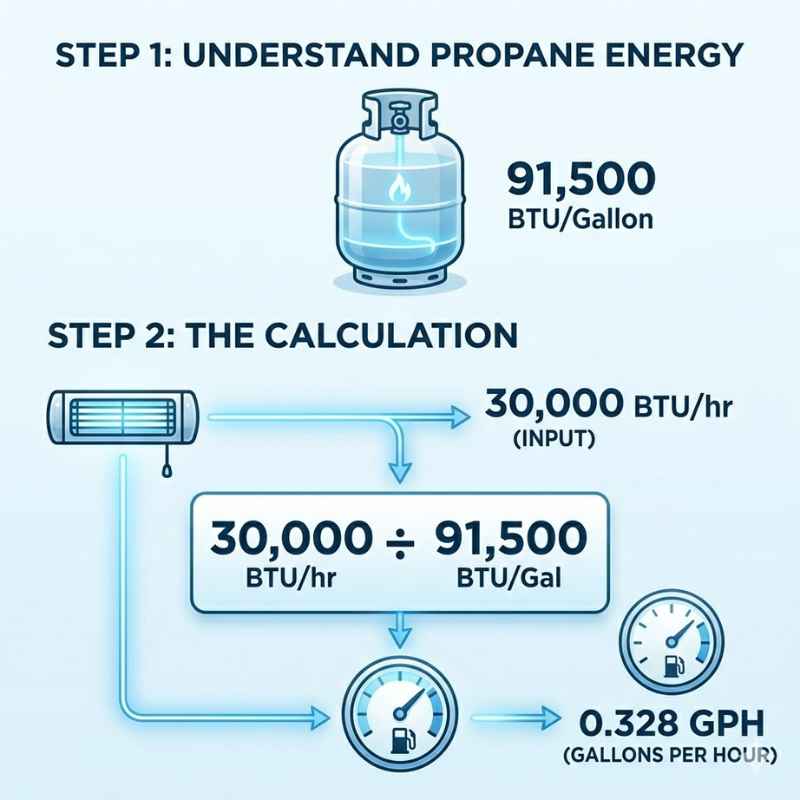
Propane has an energy content of about 91,500 BTUs per gallon. A 30,000 BTU heater burning propane at 1.3 GPH means: 1.3 GPH * 91,500 BTU/gallon = 118,950 BTUs of propane consumed per hour. The heater is designed to convert about 30,000 BTUs of this into usable heat.
The rest is lost.
Kerosene has an energy content of about 135,000 BTUs per gallon. A 30,000 BTU heater burning kerosene at 0.25 GPH means: 0.25 GPH * 135,000 BTU/gallon = 33,750 BTUs of kerosene consumed per hour. This seems much closer to the actual heat output.
This suggests kerosene heaters can be more efficient in terms of fuel energy converted to heat.
So, while a kerosene heater might use a smaller number of gallons, the fuel itself is denser in energy. This is why you might see lower GPH figures for kerosene. It’s not just about the volume of liquid.
It’s about the heat packed into that liquid.
What This Means for Your Fuel Supply
Knowing the gallons per hour helps you manage your fuel supply. If you have a 30,000 BTU propane heater running full blast, you know you’ll need a new 20-pound tank every few hours. This means planning ahead, especially if you’re working in a remote area or during extreme cold.
For kerosene, a 5-gallon tank might last for a long time if the heater is set lower. But if you run it on high, it will drain faster. It’s always wise to have extra fuel on hand.
You don’t want to run out when you need the heat the most. Having a spare tank or can is a good idea.
When you buy a heater, look at its specifications. They usually list the fuel consumption in GPH or gallons per BTU. This helps you compare different models.
It also gives you a clearer picture of ongoing costs. I learned this the hard way. I bought a heater that looked cheap but ate fuel like crazy.
Consider the type of fuel available. Propane tanks are easy to find and exchange. Kerosene might be harder to get in some areas.
Think about where you’ll be using the heater and what fuel makes the most sense for you.
Checking Your Heater’s Manual is Key
I’ve given you general numbers here. They are good starting points. But every heater is a little different.
The absolute best place to find out exactly how many gallons per hour your 30,000 BTU infrared heater uses is in its owner’s manual. Manufacturers test their products thoroughly.
Your manual will tell you the expected fuel consumption at different settings. It might also list the BTU output per hour for each fuel type. It will have important safety information too.
Always read the manual before you use a new heater. It’s not just a formality; it’s crucial for safety and performance.
If you can’t find your manual, search online for the model number. Most manufacturers have PDFs of their manuals available on their websites. Sometimes, you can even find forums or communities where people discuss specific heater models.
That’s where I find a lot of practical tips.
Key Factors for Fuel Consumption:
- BTU Output: Higher BTUs mean more heat and more fuel.
- Fuel Type: Propane vs. Kerosene have different energy densities.
- Thermostat Setting: Running on low or cycling saves fuel.
- Insulation: Better insulation means less heat loss.
- Outside Temperature: Colder days require more heating effort.
- Heater Efficiency: Different models convert fuel to heat differently.
Safety First: Always!
Using portable heaters comes with risks. Fuel burning creates carbon monoxide (CO). This is a colorless, odorless gas.
It can be deadly. Always use these heaters in well-ventilated areas. Never use them in enclosed spaces like bedrooms or basements where fresh air can’t get in easily.
Make sure you have working carbon monoxide detectors. Test them regularly. Know the symptoms of CO poisoning: headaches, dizziness, nausea, and confusion.
If you suspect CO poisoning, get everyone outside immediately. Call for emergency help. Your safety is more important than staying warm.
Also, be mindful of fire hazards. Keep heaters away from curtains, furniture, and other flammable materials. Place them on a stable, level surface.
Never leave a heater unattended when it’s running. These are simple steps but can prevent serious accidents. I always double-check placement before I turn mine on.
When to Worry About Fuel Consumption
Most of the time, your heater will use fuel as expected. But sometimes, a sudden change can be a sign of a problem. If your heater suddenly starts using a lot more fuel than it used to, something might be wrong.
This is especially true if your heating needs haven’t changed.
For example, if your propane tank is emptying much faster than before, and you haven’t changed your usage habits, check for leaks. Propane leaks are dangerous. You might smell a rotten egg odor.
If you smell gas, turn off the heater immediately. Leave the area. Call your propane supplier or 911 from a safe distance.
With kerosene heaters, an unusual fuel smell or a constantly smoky flame can indicate a problem. This might mean the wick needs adjusting or replacing, or the combustion isn’t happening efficiently. A poorly burning heater not only wastes fuel but also produces more dangerous byproducts.
If you notice a big, unexplained jump in fuel use, it’s time to check the heater. Look for visible damage. Clean any parts that seem dirty.
If you’re not comfortable troubleshooting, it’s best to have a professional check it out. Many small engine or appliance repair shops can help.
Tips for Managing Fuel Use
Here are some easy ways to be smarter about how much fuel your heater uses:
- Use a Thermostat: If your heater has one, use it! It’s the easiest way to save fuel.
- Improve Insulation: Seal air leaks around windows and doors. Add insulation to walls if possible.
- Heat Only When Needed: Don’t run the heater when no one is around. Turn it off when you leave the space.
- Zone Heating: Focus on heating the specific area you are in, not the whole building.
- Use Reflective Barriers: Place a heat-reflective shield behind the heater. This helps direct heat forward.
- Proper Venting: Ensure your heater is venting properly. Blocked vents can reduce efficiency.
- Regular Maintenance: Keep your heater clean. A well-maintained unit runs better.
Quick Fuel Management Tips:
Thermostat is your friend. Set it and forget it (mostly).
Seal drafts before you even turn the heater on.
Don’t heat empty rooms. Simple logic saves money.
Frequently Asked Questions About Heater Fuel Use
How long will a 20lb propane tank last for a 30,000 BTU heater?
A standard 20-pound propane tank holds about 4.7 gallons. A 30,000 BTU heater uses roughly 1.3 gallons per hour at full power. So, a tank would last about 3.6 hours.
This is if it runs constantly. Using a thermostat will make it last much longer.
Is kerosene or propane cheaper to run?
Generally, kerosene is often cheaper per gallon and has more energy per gallon. This means a 30,000 BTU kerosene heater can be less expensive to run than a propane one. However, prices fluctuate, so always check local fuel costs.
Can I use a 30,000 BTU heater indoors?
Only if the heater is specifically designed for indoor use and has safety features like tip-over shutoff and a CO sensor. Most portable infrared heaters are designed for garages, workshops, or outdoor patios. Never use them in a bedroom or unventilated space due to carbon monoxide risk.
What does “gallons per hour” mean for a heater?
Gallons per hour (GPH) is a measure of how much liquid fuel (like propane or kerosene) your heater burns in one hour when operating at its maximum heat output. It helps you estimate fuel costs and how long a fuel tank will last.
Why does my heater seem to use more fuel than the manual says?
The manual usually states consumption at maximum output. If you are using a thermostat, running the heater on a lower setting, or if the space is well-insulated, you will use less fuel than the maximum stated amount. Colder outside temperatures also make the heater run more.
How often should I check my propane tank for leaks?
You should check for leaks periodically, especially when connecting a new tank. You can use a soapy water solution on the connections. If you see bubbles forming, there’s a leak.
Always check if you smell gas.
Final Thoughts on Heater Fuel
Figuring out how many gallons per hour your 30,000 BTU infrared heater uses is about understanding your specific unit and how you use it. For propane, expect around 1.3 GPH, and for kerosene, about 0.2 to 0.25 GPH, at full power. Remember these are estimates.
Your actual use will depend on your settings, insulation, and the weather.
By being aware of these factors and practicing good maintenance and safety, you can use your heater effectively and efficiently. Always prioritize safety and consult your owner’s manual for the most accurate information.
Sponsored / affiliate links. As an Amazon Associate I earn from qualifying purchases. I may earn additional commission from eligible campaigns.