Will All 300 Watt Heaters Work For A 100 Gallon Tank?
It’s a common question for any aquarium owner. You’ve got a big tank, a 100-gallon beauty, and you need to keep it just right for your fish. The store has 300 watt heaters, and you wonder, “Will this one power do the job?” It’s a worry that many share.
You want your fish to be happy and healthy. You don’t want them to be too cold or too hot. Figuring out the right heater can feel like a puzzle.
This guide will help you solve it. We’ll look at heater sizes and what keeps a 100-gallon tank at a good temperature.
A 300 watt heater can work for a 100-gallon tank, but it depends on several factors like room temperature and desired water temperature. It might be enough in stable room conditions, but for faster heating or colder rooms, a higher wattage or a second heater might be needed. Always monitor your tank’s temperature closely.
Understanding Aquarium Heater Wattage
Aquarium heaters come in different power levels. This power is measured in watts. A watt is a unit of energy.
More watts mean more heat. But it’s not just about the heater’s power. It’s also about the size of your tank.
A small tank needs less power than a big one. A 100-gallon tank is quite large. It holds a lot of water.
Water holds heat well. So, it takes more energy to warm it up.
Think of it like heating your house. A small room needs a small heater. A big house needs a much bigger heater.
Or maybe several heaters. The same idea applies to aquariums. The heater’s job is to keep the water at a steady, warm level.
This level is different for different types of fish. Some fish like it tropical. Others prefer cooler water.
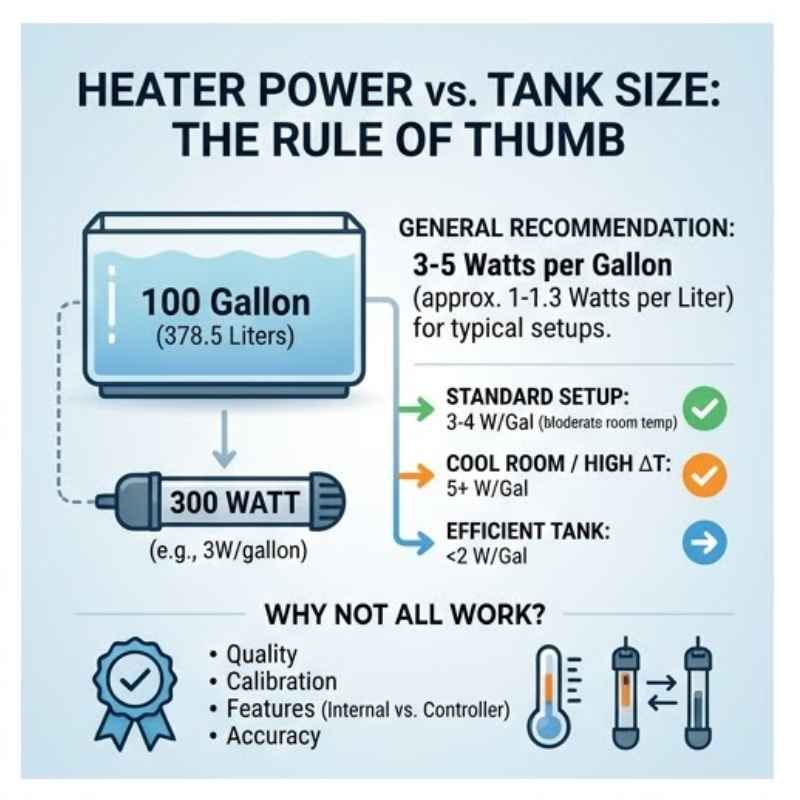
Heater wattage is usually linked to tank size. There are general rules for this. For example, a common guideline is 2.5 to 5 watts per gallon.
This is a starting point. It helps you pick a heater size. For a 100-gallon tank, this rule would suggest a heater between 250 and 500 watts.
So, a 300 watt heater falls right in the lower end of this range.
This wattage is for average conditions. What are average conditions? It means the room where your tank is kept isn’t too hot or too cold.
If your house is kept at a steady 70-75 degrees Fahrenheit, a 300-watt heater might be okay. But if your room gets much colder, the heater will have to work harder. It might struggle to keep up.
Why Room Temperature Matters So Much
The temperature of the room surrounding your aquarium is a big deal. It’s like putting a sweater on a cold day. If the air is cold, the water loses heat faster.
The heater has to constantly put heat back into the water. If the room is very cold, say in a basement during winter, your heater will work overtime.
Let’s say your room is usually around 65 degrees Fahrenheit. And your fish need the water to be 78 degrees Fahrenheit. That’s a 13-degree difference.
Your heater needs to make up that difference. If the room is 72 degrees Fahrenheit, and your fish need 78 degrees, that’s only a 6-degree difference. The heater has less work to do.
It will be more effective.
This is why guidelines are just that—guidelines. They are not strict rules. If you live in a cold climate or keep your house cooler, you might need more power.
You might need a heater that is 5 watts per gallon or even more. For a 100-gallon tank, that could mean a 500-watt heater. Or it might mean using two smaller heaters.
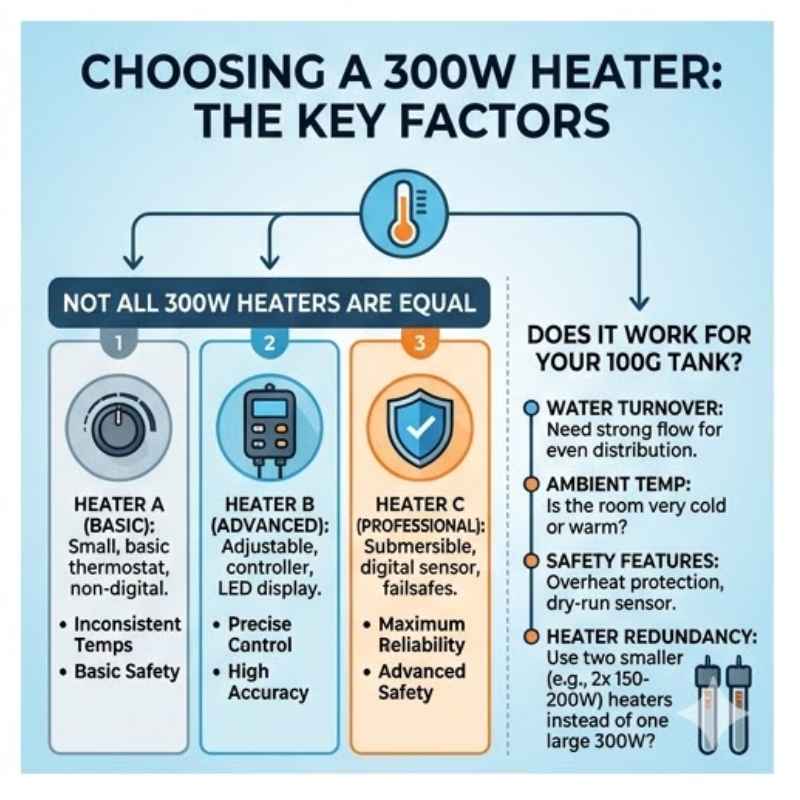
Using two heaters can be a smart move. It offers a backup. If one heater breaks, the other can help keep the temperature stable.
It also helps distribute heat more evenly. This stops hot spots in the tank. A 300-watt heater alone might struggle in a cold room.
You’d notice the temperature drop. The heater would run a lot.
Heater Wattage Quick Guide
General Rule: 2.5 – 5 Watts per Gallon
For a 100-Gallon Tank:
- Standard Room Temp (70-75°F): 300 Watts might be enough.
- Cooler Room Temp (<70°F): Consider 400-500 Watts or two heaters.
- Tropical Fish (80°F+): May need higher wattage, especially in cooler rooms.
It’s really about the temperature difference. The bigger the gap between room air and tank water, the more power you need. Your 300 watt heater is designed for a certain range.
It works best when it doesn’t have to fight against a cold environment too hard. If the difference is too big, it will just run constantly and still might not reach the target temperature.
The Importance of Stable Tank Temperature
Fish are cold-blooded. This means their body temperature matches the water around them. They don’t make their own heat.
So, the water temperature is critical for their health. Fluctuations can stress them out. Stress makes them sick.
It weakens their immune systems.
Imagine you felt cold one minute and hot the next. You’d feel unwell. Fish have a similar reaction.
They have a preferred temperature range. Staying within this range is vital for their survival. It affects their metabolism, their immune system, and their behavior.
They might eat less or become lethargic if the water is too cold.
If the water is too warm, they can also suffer. Their oxygen levels drop. They can become stressed and even overheat.
This is why precision is important. A heater doesn’t just add heat. It’s meant to keep the temperature stable.
It turns on when the water cools and turns off when it’s warm enough.
A 300 watt heater has a certain heating capacity. It can raise the temperature of 100 gallons of water by a certain amount over a period. If the target temperature is only a few degrees above room temperature, it can likely do this.
But if the target is 10 or 15 degrees higher, it will struggle.
Most aquarium heaters also have a built-in thermostat. This is the part that senses the water temperature. It tells the heater when to turn on and off.
The accuracy of this thermostat is also important. Some are more precise than others. Cheaper heaters might have less accurate thermostats.
This leads to bigger temperature swings.
My Own Heater Scare
I remember this one time. I was setting up a new 75-gallon tank. I had a 200-watt heater.
It seemed like the right size based on the guidelines. I got everything set up. I filled it with water.
I set the heater to 78°F. I went to bed feeling pretty good.
The next morning, I woke up to a chilly house. It had been unusually cold overnight. I walked over to the tank.
The thermometer showed 68°F. That’s a 10-degree drop! My fish looked miserable.
They were huddled near the (now cold) heater. I felt a wave of panic. My heater had clearly failed to keep up.
I realized then how much the room temperature really mattered. My house was older and not well-insulated. That 200-watt heater just couldn’t fight the cold air.
I ended up needing to add a second 200-watt heater to that tank. It was a stressful lesson. It taught me to always consider the environment.
For my current 100-gallon tank, I learned from that experience. I live in a place with pretty stable indoor temperatures. I use a 300-watt heater.
But I also have a second 150-watt heater as a backup and to ensure even heating. I check the temperature daily. I learned that being proactive saves a lot of worry.
Real-World Tank Temperature Checks
Scenario: A 100-gallon tank with a 300-watt heater.
Observation 1 (Stable Room, 72°F): Heater turns on briefly twice a day. Water stays at 77-78°F. (Good)
Observation 2 (Cold Room, 65°F): Heater runs almost constantly. Water struggles to reach 75°F. (Concerning)
Observation 3 (Warm Room, 80°F): Heater rarely turns on. Water stays at 78-79°F. (Fine, but check for overshooting)
When a 300 Watt Heater Might Be Enough
So, when can a 300 watt heater actually do the job for a 100-gallon tank? Here are a few situations where it’s more likely to be sufficient:
- Stable Room Temperature: If the room where the tank is located stays consistently between 70°F and 75°F, a 300-watt heater often has enough power. The temperature difference it needs to overcome is small.
- Lower Target Temperature: If your fish are hardy and don’t need a super-tropical 80°F or higher, and you’re aiming for something like 74-76°F, a 300-watt heater might manage. This is especially true if the room is also on the warmer side.
- Multiple Heaters: Even if one heater is 300 watts, if you have a second, smaller heater (say, 100 or 150 watts), the combined wattage might be enough. This also helps spread the heat.
- Well-Insulated Room: If the room itself retains heat well, the water won’t lose heat as quickly to the environment. This makes the heater’s job easier.
In these scenarios, the 300-watt heater is working within its optimal range. It’s not being pushed to its absolute limit. This is good for the heater’s lifespan and for keeping the temperature stable.
It means the heater will cycle on and off normally, without running non-stop. This consistency is key for your fish’s well-being.
It’s also worth noting the type of heater. Some heaters are more efficient than others. Submersible heaters are generally good.
But make sure it’s fully submerged according to the manufacturer’s instructions. Also, ensure good water flow around the heater. This helps distribute the heat evenly.
When You Need More Power (or a Second Heater)
Conversely, there are times when a single 300-watt heater is definitely not enough for a 100-gallon tank. Ignoring these signs can lead to big problems for your fish:
- Cold Room Temperatures: If your house is often below 70°F, especially during winter, the 300-watt heater will struggle. The water will cool down faster than the heater can warm it.
- High Target Temperatures: If you keep tropical fish that need temperatures of 80°F or higher, a 300-watt heater might not be able to reach and maintain that level, especially if the room is not very warm.
- Drafty Areas: Tanks placed near windows, doors, or in drafty rooms will lose heat rapidly. The heater will constantly be battling the cold air currents.
- Water Changes: When you do large water changes with cooler water, the heater has to work harder to bring the entire tank back up to temperature. A higher wattage or a second heater helps this process.
- Tank Location: If the tank is in a room that gets very cold at night, or if you turn down the thermostat, this will impact your heater’s performance.
In these situations, you have a few options. The most straightforward is to upgrade to a more powerful heater. For a 100-gallon tank, this could mean a 400-watt or even a 500-watt heater.
Make sure to check the manufacturer’s recommendations for the specific wattage you choose.
Another excellent strategy is to use two heaters. For a 100-gallon tank, two 200-watt heaters would provide 400 watts total. Or you could use a 250-watt and a 150-watt heater.
This setup offers redundancy. If one heater fails, the other can often prevent a catastrophic temperature drop. It also ensures more even heat distribution throughout the tank, which is great for fish health.
Signs Your Heater Isn’t Powerful Enough
- Constant Running: The heater light stays on almost all the time.
- Temperature Drops: The water temperature falls significantly, especially at night or when the room is cooler.
- Fish Behavior: Fish become lethargic, stay near the bottom, or show signs of stress.
- Thermostat Issues: You notice large swings between the heater turning on and off.
Checking Your Tank’s Actual Temperature
No matter what size heater you use, the most important thing is to check the actual water temperature. Don’t just trust the dial on the heater. Those dials can be inaccurate.
Invest in a reliable aquarium thermometer. A digital thermometer or a good glass thermometer is a good choice.
Place the thermometer in a different part of the tank than the heater. This gives you a more accurate reading of the overall water temperature. Check it daily, especially when you first set up a heater or make changes.
Look for trends. Is the temperature slowly dropping? Is it swinging too much?
You can use a reliable thermometer to calibrate your heater’s thermostat. Set the heater to a certain temperature. Then, watch the thermometer.
When the thermometer reaches your desired temperature, check the heater’s setting. You might need to adjust the heater dial slightly up or down to match. Some high-end heaters have digital displays that are more accurate.
Consider using two thermometers in a large tank. One near the heater and one on the opposite side. This helps you see if there are any significant temperature gradients.
Good water flow from your filter or powerheads helps prevent these gradients. It ensures the warm water from the heater reaches all parts of the tank.
The 300 watt heater might seem like the right choice on paper. But real-world conditions will tell the true story. Regular monitoring with a good thermometer is your best friend.
It’s the ultimate test of whether your heating setup is working. It’s your early warning system.
Best Practices for Aquarium Heating
To ensure your fish are safe and comfortable, follow these best practices for aquarium heating:
- Always Use a Thermometer: This cannot be stressed enough. Monitor your tank temperature daily.
- Use Two Heaters for Larger Tanks: For tanks over 50 gallons, consider using two smaller heaters instead of one large one. This provides redundancy and better heat distribution. For a 100-gallon tank, two 150-watt or 200-watt heaters are often a safer bet than one 300-watt heater.
- Match Heater Wattage to Room Conditions: Don’t just follow the tank size rule. Consider how warm or cold the room your tank is in tends to be.
- Proper Placement: Place heaters near the filter output or water flow. This helps distribute the heat quickly and evenly. Ensure the heater is fully submerged as per manufacturer instructions.
- Avoid Hot Spots: Good water circulation prevents the water right next to the heater from becoming too hot while the rest of the tank is cool.
- Test New Heaters: Before relying on a new heater, test it for a few days to ensure it maintains the set temperature accurately.
- Regular Maintenance: Clean your heaters periodically as instructed by the manufacturer. Algae or mineral buildup can affect their performance.
- Consider a Heater Controller: For ultimate stability, especially in critical setups, an external heater controller can offer more precise temperature control and safety features than a heater’s built-in thermostat.
Following these steps will help you maintain a stable and healthy environment for your aquatic pets. A 300 watt heater might be a piece of the puzzle, but it’s part of a larger system of care. Making informed choices based on your specific setup is crucial.
Don’t be afraid to use more wattage or a second heater if your conditions call for it.
What This Means for Your 100 Gallon Tank
So, will a 300-watt heater work for your 100-gallon tank? The short answer is: maybe. It depends on your specific situation.
It’s not a simple yes or no.
If your room temperature is stable and mild (70-75°F), and your fish don’t need very high temperatures (76-78°F), then a single 300-watt heater could be enough. You’ll need to monitor it closely with a good thermometer.
However, if your room gets cold, or if you need to maintain higher temperatures (80°F+), a 300-watt heater is likely too weak. In these cases, you should strongly consider a more powerful single heater (400-500 watts) or, ideally, two heaters that add up to sufficient wattage (e.g., two 200-watt heaters). This provides better stability and a safety net.
Think of the 300-watt heater as a potential starting point. But always be prepared to supplement it. Your fish’s health depends on a consistent temperature.
It’s better to be slightly over-prepared with heating than under-prepared. A consistent, comfortable temperature is one of the most important factors in a thriving aquarium ecosystem.
Frequently Asked Questions About Heater Sizing
How many watts per gallon do I really need for a 100-gallon tank?
The general rule is 2.5 to 5 watts per gallon. For a 100-gallon tank, this means 250 to 500 watts. A 300-watt heater falls into the lower end of this range.
It might be sufficient in stable, warmer room conditions. For colder rooms or higher temperature needs, aim for the higher end or use multiple heaters.
Can I use two smaller heaters instead of one large one for my 100-gallon tank?
Yes, absolutely! For larger tanks like 100 gallons, using two heaters is often recommended. For example, two 200-watt heaters provide 400 watts total and offer better heat distribution and a safety backup if one heater fails.
This is generally a safer and more stable setup.
What happens if my heater is not powerful enough for my 100-gallon tank?
If a heater is not powerful enough, it will struggle to raise the water temperature to the desired level. The water temperature may remain below the target, especially during colder periods. This can stress your fish, weaken their immune systems, and make them susceptible to diseases.
The heater will also run constantly, potentially shortening its lifespan.
How can I tell if my aquarium heater is working correctly?
You should see the indicator light on the heater turn on when it’s actively heating and off when the water reaches the set temperature. Most importantly, use a reliable aquarium thermometer placed away from the heater to verify that the water temperature is stable and at the desired level. Check it daily.
What is the ideal temperature for most freshwater aquarium fish?
Most common freshwater tropical fish prefer temperatures between 75°F and 80°F (24°C to 27°C). However, this can vary widely. Some fish, like certain tetras or corydoras, prefer slightly cooler water, while others, like discus fish, require warmer temperatures.
Always research the specific needs of your fish species.
How do I adjust my heater if the temperature is too low or too high?
Most aquarium heaters have an adjustable dial. Turn the dial slightly to increase or decrease the target temperature. After adjusting, wait several hours (or even a full day for a large tank) to see the effect.
Monitor your thermometer closely and make small adjustments as needed to reach and maintain the desired temperature.
Conclusion
Keeping your 100-gallon tank at the right temperature is crucial. A 300 watt heater can be part of the solution. But it’s not a guaranteed fix for every situation.
Always consider your room’s temperature. Pay attention to the specific needs of your fish. Using a reliable thermometer daily is your best tool.
For larger tanks, redundancy with two heaters is often the smartest choice. This ensures a stable, healthy home for your aquatic friends.
Sponsored / affiliate links. As an Amazon Associate I earn from qualifying purchases. I may earn additional commission from eligible campaigns.