What Is The Difference Between Commercial & Residential Water Heaters?
Buying a new water heater can feel like a big decision. You might be looking at your old one, wondering if it’s time for a change. Or maybe you’re building something new.
Either way, you’ve probably seen different types. Some are small and simple. Others look much bigger and more serious.
This often leads to a big question: what’s the actual difference between a water heater for a home and one for a business? It’s not just about size. There are important reasons why they are built differently.
Understanding these differences helps you pick the best one. It ensures you have enough hot water when you need it. And it helps you save money too.
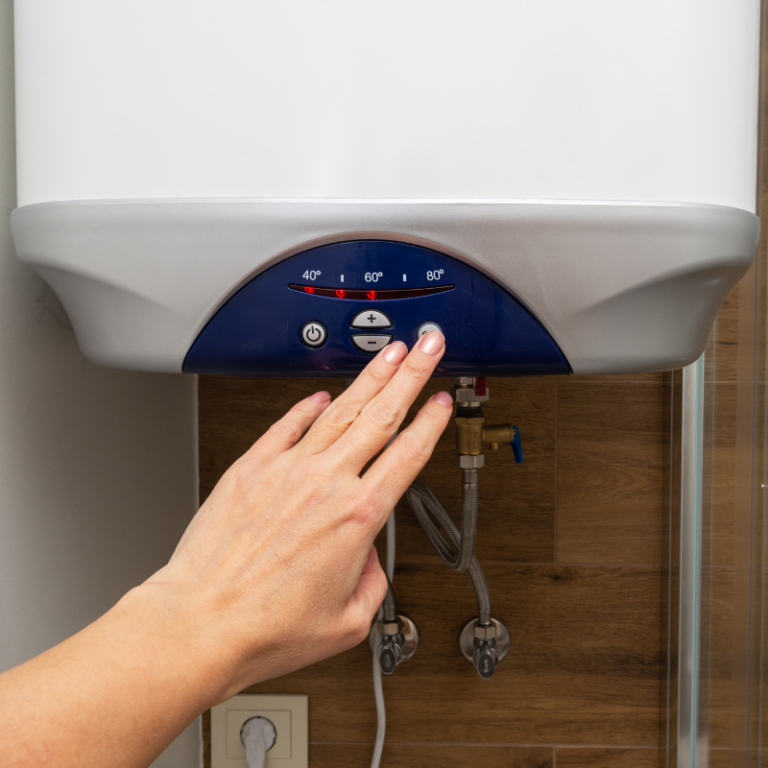
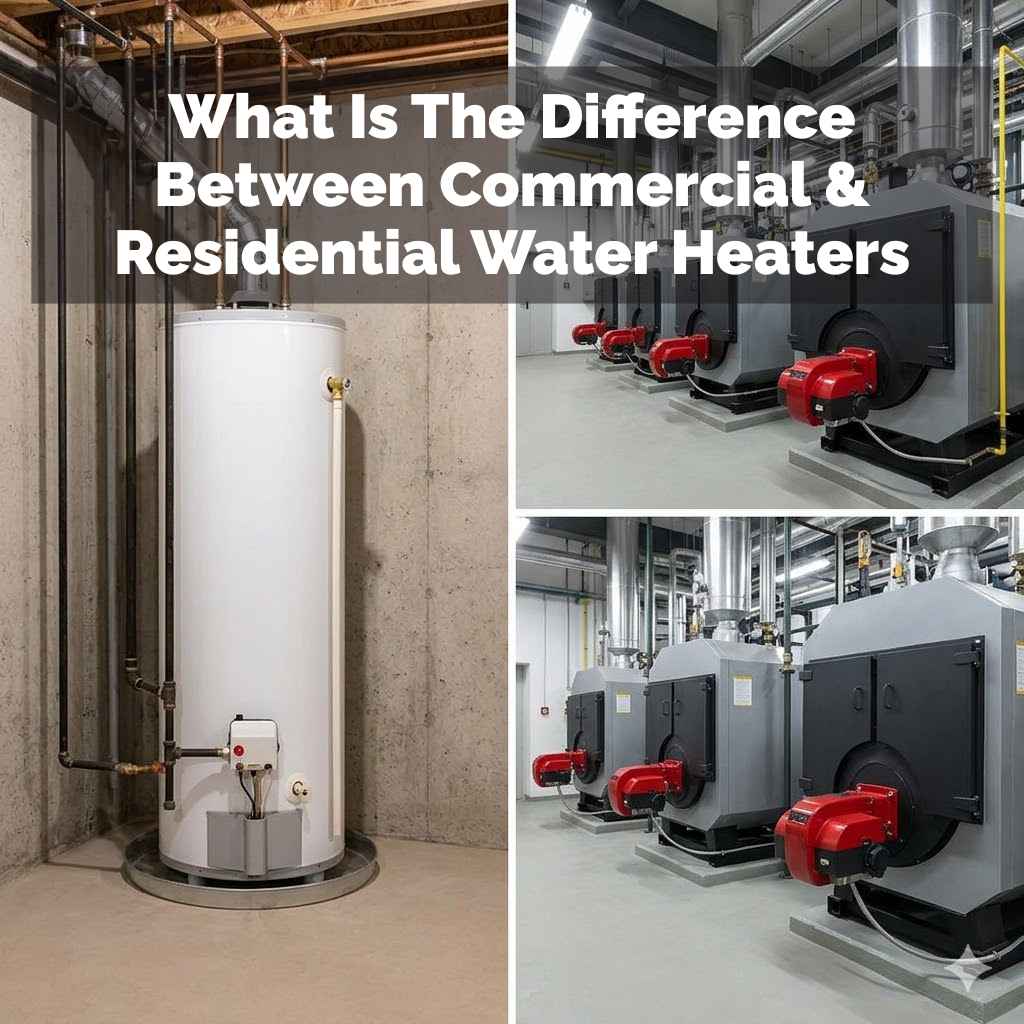
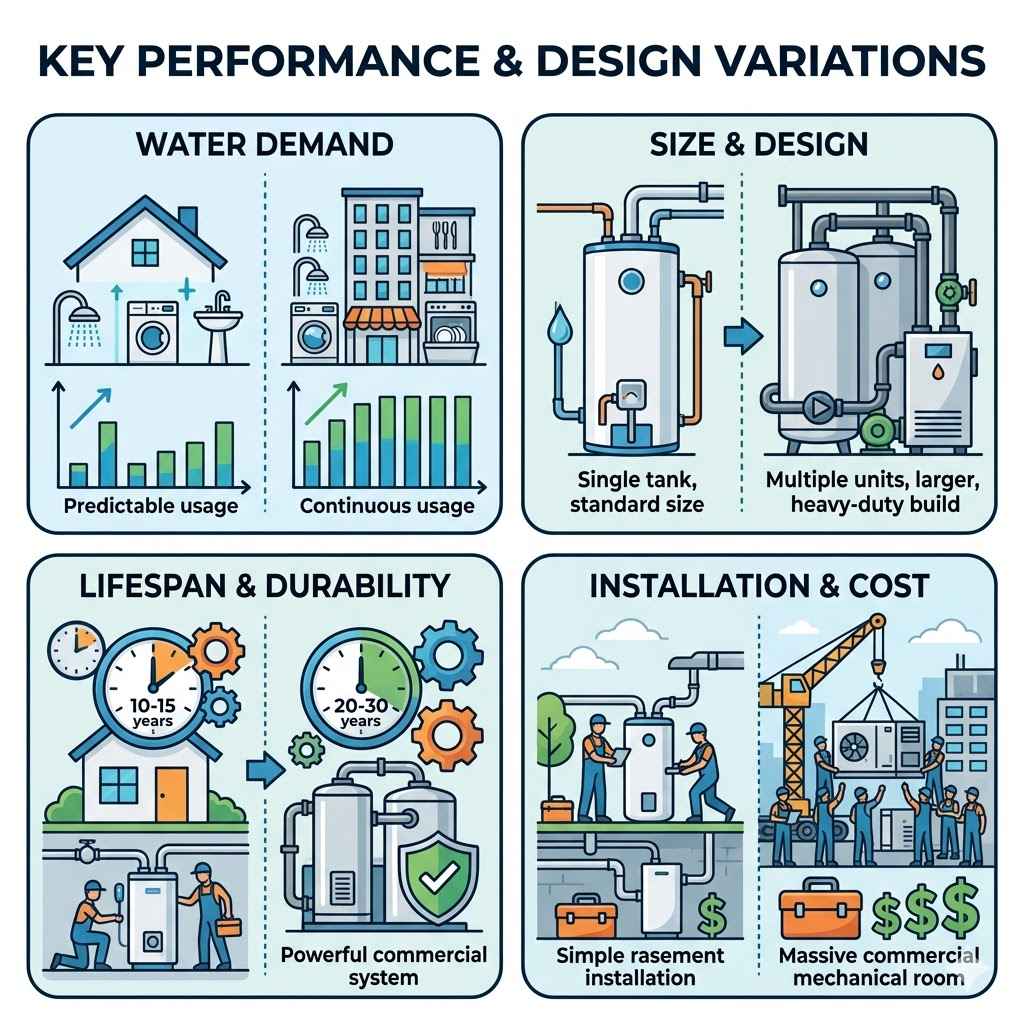
The core difference between commercial and residential water heaters lies in their intended use, leading to significant variations in size, capacity, heating power, durability, and efficiency features designed to meet the distinct demands of each environment.
Understanding the Basics: What Makes Them Different?
At first glance, they might seem similar. They both heat water. They both store it.
But the jobs they do are very different. Think about a busy restaurant. They need hot water constantly.
For dishes, for cleaning, for cooking. Now think about your own home. You need hot water for showers, laundry, and washing hands.
The amount and the speed at which hot water is needed are not the same.
This difference in need means the heaters are built differently. Commercial units are workhorses. They are designed for heavy, constant use.
Residential units are built for typical home schedules. They don’t usually face the same high demands all day long. This affects everything from the tank size to the materials used inside.
It even changes how they are installed and maintained.
The goal for a home is often comfort and convenience. The goal for a business is almost always about continuous operation and meeting customer needs. This drives the design and engineering of each type.
So, while they both perform the same basic function, their design reflects their very different jobs.
Commercial Water Heaters: Built for the Big Jobs
Commercial water heaters are designed for places like restaurants, hotels, gyms, hospitals, and apartment buildings. These places use a lot more hot water. And they need it right away.
A restaurant might run dishwashers all day. A hotel needs hot showers for many guests. A gym needs showers for members.
This means commercial units have to be much more powerful. They usually have larger storage tanks. Some can hold 50, 100, or even more gallons.
They also heat water faster. This is often called the “recovery rate.” A higher recovery rate means it can heat up a new batch of cold water more quickly. This is crucial when demand is high.
The construction of commercial heaters is also tougher. They are made with stronger materials. This helps them withstand constant use and higher pressures.
They often have better warranties too. This is because they are expected to last a long time under tough conditions. Think of it like a heavy-duty truck versus a family car.
Both get you places, but one is built for much harder work.
Efficiency is also a big factor, but in a different way. While energy savings are important, the priority is often on ensuring there’s always enough hot water. Some commercial units use special technologies to heat water more quickly or efficiently, even with high demand.
They might have multiple heating elements or advanced burner systems. These help them keep up with the pace.
Installation is also different. Commercial water heaters often need special venting. They might connect to larger gas lines or electrical circuits.
They can be quite large and heavy. This means professional installation is almost always required. It’s not a DIY job.
Residential Water Heaters: Designed for Home Comfort
Residential water heaters are made for typical houses and apartments. The hot water needs are much lower and more spread out. You might use a lot of hot water for a shower.
Then, there might be several hours before the next big use, like laundry or washing dishes. This allows the heater time to recover and heat up the stored water.
These heaters usually have smaller tanks. Common sizes are 40, 50, or 60 gallons. They still heat the water well, but their recovery rate is typically slower than commercial units.
For most homes, this is perfectly fine. You might notice a slight wait if multiple showers are happening at once. But usually, it’s not a major problem.
Residential units are built to be cost-effective. They focus on providing reliable hot water without breaking the bank. They are generally less expensive to buy and install.
They are also designed to be fairly energy-efficient for home use. Many meet ENERGY STAR standards. This helps lower your utility bills.
The materials used are good for home use. They are durable enough to last many years. But they are not built for the constant, high-volume demands of a business.
Think of it as a well-made appliance for your home. It’s reliable for everyday tasks.
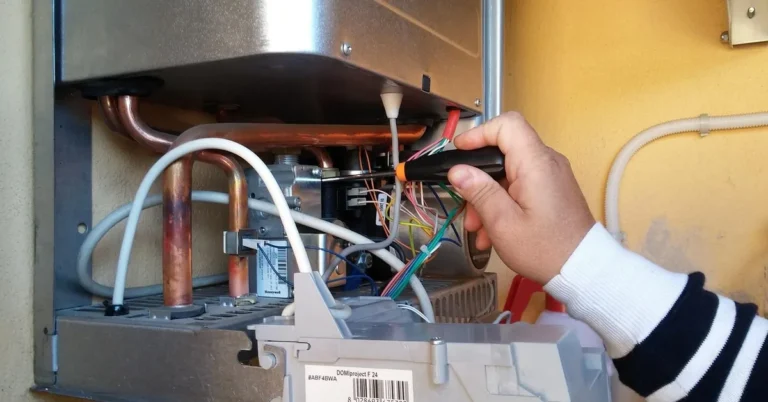
Installation for residential heaters can sometimes be done by a skilled homeowner. However, it’s still highly recommended to use a qualified plumber. This ensures safety and proper function.
They connect to standard gas lines or electrical panels found in homes. They are typically smaller and lighter than commercial models.
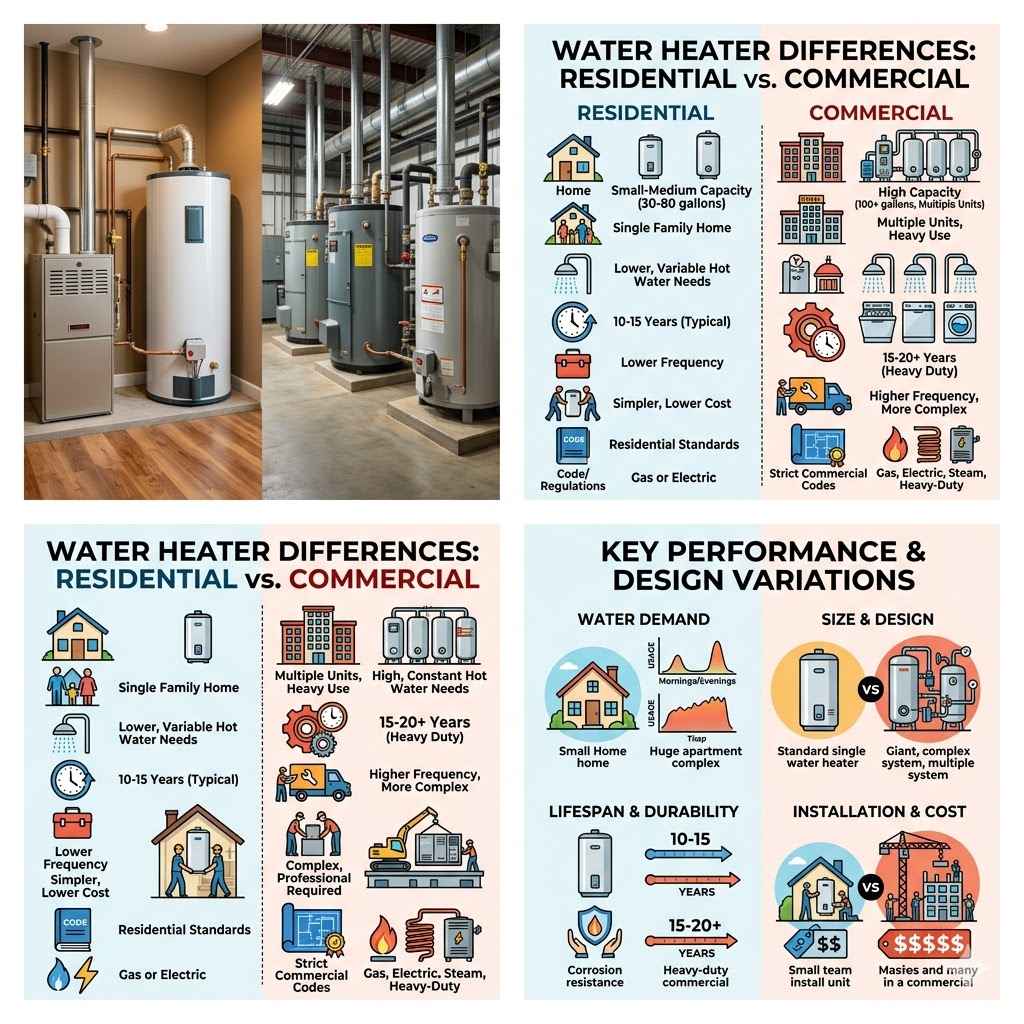
Key Differences at a Glance
Tank Size:
Commercial: Larger (50-100+ gallons typically)
Residential: Smaller (40-60 gallons typically)
Heating Power / Recovery Rate:
Commercial: High (heats water quickly)
Residential: Moderate (heats water at a slower pace)
Durability & Construction:
Commercial: Heavy-duty, built for constant use
Residential: Standard, built for typical home use
Cost:
Commercial: Higher upfront cost
Residential: Lower upfront cost
Capacity and Flow Rate: Meeting Demand
When we talk about water heaters, “capacity” is a big word. For residential units, capacity usually means the size of the tank. A 50-gallon tank holds 50 gallons of hot water.
When you use some, cold water mixes in to reheat. It’s a buffer.
Commercial units also have tank size capacity. But what’s more important for them is the flow rate. This is how much hot water can be delivered at any given moment.
A restaurant needs to run multiple sinks and dishwashers. All at the same time. A high flow rate means there’s always enough hot water to go around, without the temperature dropping.
Think about a busy restaurant kitchen. The dishwasher needs a steady stream of very hot water. A cook might need hot water for a pot.
Someone else might be washing their hands. If the water heater can’t keep up, the temperature will drop. This causes problems.
Dishes won’t get clean. It’s uncomfortable. It can even be unsanitary.
Commercial heaters often use larger pipes. They have more powerful heating elements or burners. Some are “tankless” commercial models.
These heat water on demand. They can provide an endless supply of hot water. But they need very strong gas lines or electrical service to work.
They are designed for peak demand, not just average use.
Residential units are simpler. Their capacity is mostly about the tank size. And their flow rate is usually good enough for a few simultaneous uses.
A shower and a washing machine might be fine. But adding another shower might start to stretch it. You’ll notice the temperature change if you push it too hard.
Heating Power and Recovery Rate: The Speed Factor
The recovery rate is how fast a water heater can heat a full tank of water. Or, more importantly, how fast it can heat up the incoming cold water to reach the set temperature. This is a huge difference between commercial and residential models.
Imagine a residential 50-gallon tank. If you use all 50 gallons for a long bath, it might take an hour or more to reheat completely. For most homes, this is not an issue.
You won’t use 50 gallons all at once. Or if you do, you’re okay waiting for the next batch.
Now, picture that busy restaurant again. The dishwasher finishes a load. It drains.
Then it starts a new cycle. It needs a full tank of hot water now. If the heater takes an hour to recover, the restaurant can’t operate properly.
Commercial units have much higher recovery rates. They can heat up large volumes of water much faster.
This is achieved through more powerful heating elements or burners. Some commercial units use multiple heating elements. Others have much larger gas burners.
Some even use “multi-stage” heating. This means they have different levels of power they can use. They can ramp up to heat quickly when needed.
Then dial back to maintain temperature efficiently.
This high recovery rate is a key reason why commercial units cost more. The components are more robust and powerful. They are built to handle the constant demand for quick reheating.
For a home, this level of power is usually overkill. It would also use a lot more energy than needed.
Understanding Recovery Rate
What it is: How quickly a water heater can heat up a tank of water from cold to its set temperature.
Why it matters for Commercial: Businesses need hot water constantly. A high recovery rate prevents a “run out” of hot water during peak times.
Why it’s less critical for Residential: Homes have less intense, more spread-out hot water needs. Slower recovery is usually acceptable.
How it’s achieved: Larger burners/elements, multiple heating sources, advanced controls.
Durability and Construction: Built to Last
When you buy a commercial water heater, you’re investing in a piece of equipment that’s meant to run almost non-stop for years. The construction reflects this. They are built with heavier-duty materials.
The tanks are often made of thicker steel. They might have special coatings or liners to prevent corrosion from constant use.
The internal components are also tougher. Heating elements are made to withstand more cycles. Thermostats and controls are more robust.
They are designed to handle the stress of constant operation. Think about the difference between a tool you use once a week versus one you use eight hours a day, five days a week.
Residential water heaters are made to last a good number of years. Maybe 10 to 15 years on average. They use good quality materials for home use.
But they are not engineered for the same level of constant, high-volume stress. The tank might be thinner. The components might be rated for fewer cycles.
This difference in durability also affects the price. The heavier-duty components and thicker materials cost more to produce. This is why commercial units have a higher upfront cost.
But they are also expected to have a longer lifespan under their demanding conditions. They are an investment in reliable operation for a business.
Some commercial units might even feature “commercial grade” components. These are parts specifically tested for longer life and higher performance in business settings. This level of engineering is not usually found in standard residential models.
It’s a key indicator of their intended use.
Energy Efficiency: A Different Kind of Savings
Both commercial and residential water heaters aim for energy efficiency. However, the priorities can differ. For a home, saving money on utility bills is a primary driver for choosing an efficient model.
For a business, while cost savings are important, ensuring enough hot water is always available often comes first.
Residential heaters often focus on insulation. They have thick jackets of foam to keep the water hot. They also have advanced thermostats to maintain temperature precisely.
Many meet ENERGY STAR requirements, which are set by the U.S. Environmental Protection Agency. These standards mean they use less energy to do their job.
Commercial units also have insulation. But because they are working so hard, they might use more energy overall just to keep up. Some high-end commercial models use advanced heat pump technology or condensing technology.
These can be extremely efficient. But they also come with a much higher price tag.
Another factor is how they are used. A commercial unit might be set to a higher temperature. Or it might run for longer periods.
This naturally uses more energy. A business might also choose a more powerful unit for reliability, even if it’s slightly less efficient per gallon heated. The cost of downtime from no hot water can be far greater than the energy savings.
For a homeowner, looking for the highest Energy Factor (EF) or Uniform Energy Factor (UEF) is key. These numbers tell you how efficient the unit is. For a business, it’s a balance.
They look for efficiency, but not at the expense of performance. Sometimes, a slightly less efficient but much more powerful heater is the better business choice.
Energy Efficiency Focus
Residential Goal: Maximize savings on utility bills while providing enough hot water for home use.
Commercial Goal: Balance energy use with the absolute need for continuous hot water supply. Reliability often comes first.
Key Residential Features: Thick insulation, advanced thermostats, ENERGY STAR ratings.
Key Commercial Considerations: High-efficiency burners, advanced heat recovery systems, condensation technology (on some models).
Installation and Venting: What’s Required?
Installing a water heater is more than just hooking up pipes. It involves safety. It involves proper operation.
And it involves meeting local codes. The installation needs for commercial and residential units can be very different.
Commercial water heaters often need more robust venting systems. This is because they can burn more fuel. Or they operate at higher temperatures.
The venting needs to safely carry exhaust gases away from the building. This often means larger vent pipes. Sometimes, special materials are needed for the vents.
This is to handle higher heat or corrosive byproducts.
Residential heaters also need venting. For gas units, this is crucial. Proper venting prevents carbon monoxide buildup.
Home units typically use standard PVC or metal venting. The size and type depend on the model and local building codes. Electric residential units usually don’t have complex venting needs.
Another installation difference is power. Commercial units, especially larger gas ones, might require dedicated gas lines with higher flow rates. Electric commercial units need much higher amperage circuits than residential ones.
They can draw a lot of power. This means that the building’s electrical system needs to be able to handle it.
Residential gas heaters connect to standard home gas lines. Electric ones use common household circuits. Professional installation is always recommended for both.
But for commercial units, it’s almost always mandatory. There are more complex safety checks. And the systems are more powerful.
When you install a water heater, it’s a good idea to check with your local building department. They will have specific rules you need to follow. These rules ensure safety for everyone.
Cost: Upfront vs. Long-Term
The price tag is a major difference. Commercial water heaters are significantly more expensive to buy. This is due to their larger size, more powerful components, and heavier-duty construction.
A basic 50-gallon residential unit might cost $500 to $1,000. A comparable commercial unit could easily be $1,500 to $3,000 or more.
Installation costs are also typically higher for commercial units. This is because of the more complex plumbing, electrical, and venting work involved. It requires more specialized labor.
You might pay $500 to $1,500+ for residential installation. Commercial installation can range from $1,000 to $3,000+.
However, the long-term cost picture can be more nuanced. Commercial units are built to last longer under heavy use. So, while the upfront cost is higher, they might not need to be replaced as often as a residential unit pushed beyond its limits.
They are designed for a longer service life in demanding conditions.
Energy costs are also a factor. A more powerful commercial unit might use more energy overall. But if it’s a highly efficient commercial model, it could still be cost-effective in the long run, especially when you factor in the cost of potential downtime if a less powerful unit couldn’t keep up.
For a homeowner, the goal is usually to find the lowest upfront cost that still meets their hot water needs reliably for many years. For a business, the calculation often involves total cost of ownership. This includes purchase price, installation, energy use, maintenance, and the cost of any potential business interruption if the water heater fails.
Cost Comparison
Residential Water Heaters:
- Upfront Purchase: Lower ($500 – $1,000 typical)
- Installation: Less expensive ($500 – $1,500 typical)
- Lifespan: 10-15 years
Commercial Water Heaters:
- Upfront Purchase: Higher ($1,500 – $3,000+ typical)
- Installation: More expensive ($1,000 – $3,000+ typical)
- Lifespan: Longer, designed for heavy use
When to Choose Which: Practical Scenarios
Knowing the differences helps you make the right choice. Let’s look at some real-world examples.
Scenario 1: A Family Home
A family of four lives in a suburban house. They have two bathrooms. They use hot water for showers in the morning, laundry during the day, and dishes in the evening.
A standard 50-gallon residential gas water heater is usually perfect. It has enough capacity and a good enough recovery rate for their needs. They don’t need a commercial unit’s power.
Scenario 2: A Small Cafe
A cafe has a small kitchen. They wash dishes by hand, have a coffee machine that needs hot water, and a small restroom sink. They don’t have a commercial dishwasher.
A 40-gallon or 50-gallon residential water heater might work. However, if they get very busy, and multiple sinks are used at once, they might need to consider a slightly larger residential unit or a smaller commercial one for better peace of mind.
Scenario 3: A Busy Restaurant
A popular restaurant has a commercial dishwasher, multiple prep sinks, dishwashing stations, and customer restrooms. They need a constant supply of very hot water, all day long, even during peak dinner rushes. A standard residential heater would fail quickly.
They absolutely need a commercial-grade water heater. Likely a larger tank model or a high-capacity tankless commercial unit.
Scenario 4: A Small Apartment Building
An owner has a building with four small apartments. Each apartment has one bathroom and a small kitchen. The combined demand for hot water can be high, especially if several tenants take showers around the same time.
A single large residential unit might not be enough. They would likely need a commercial water heater, perhaps a smaller commercial model or even two units working together, to ensure all apartments have reliable hot water.
The key is to honestly assess your hot water usage. How many people are there? How many fixtures use hot water simultaneously?
What is the peak demand like? For most homes, residential is the answer. For businesses with high, consistent demand, commercial is the way to go.
Can You Use a Commercial Water Heater at Home?
Yes, you absolutely can use a commercial water heater in a residential setting. There’s no rule against it. If your home has extremely high hot water demands – maybe you have a very large family, frequently host many guests, or have special needs like a home-based spa – a commercial unit might seem appealing.
However, it’s usually not the best choice for several reasons. Firstly, the cost is significantly higher. You’d be paying much more for the unit itself and for its installation.
Secondly, the powerful heating elements or burners in commercial units can be overkill for a typical home. They might consume more energy than a comparable residential unit, leading to higher utility bills. Thirdly, they are often louder and require more robust venting, which can be challenging or costly to set up in a standard home.
Also, many commercial units are designed to be installed in specific commercial spaces. They might have different warranty terms or maintenance requirements. The complexity might just not be worth it for the average homeowner.
Unless you have a very specific, documented need for extreme hot water capacity that a high-end residential unit can’t meet, sticking with a residential model is generally more practical and economical.
Can You Use a Residential Water Heater for a Business?
Using a residential water heater in a commercial setting is generally a bad idea. It’s not designed for the demands of a business. Here’s why:
- Insufficient Capacity: Most businesses use far more hot water than a home. A residential unit will quickly run out of hot water. This leads to unhappy customers and operational problems.
- Short Lifespan: Commercial use is constant and heavy. A residential unit will wear out much faster. It will likely fail prematurely.
- Code Violations: Many building codes and health regulations require commercial establishments to have commercial-grade equipment. Using a residential unit might put your business out of compliance.
- Warranty Issues: Most manufacturers explicitly state their residential warranties are void if the unit is used for commercial purposes. You’d have no warranty protection.
So, while technically you could install one, it would be a false economy. You’d end up replacing it frequently, dealing with constant service interruptions, and potentially facing legal or regulatory issues. It’s always best to match the equipment to the job it needs to do.
Residential vs. Commercial: Quick Cheat Sheet
Choose Residential If:
- You own a single-family home or condo.
- Your hot water usage is typical for a family.
- You want a balance of performance and cost.
Choose Commercial If:
- You own a business (restaurant, gym, hotel, etc.).
- Your hot water demand is high and continuous.
- You need to ensure hot water is always available.
- You are building or renovating a commercial space.
What This Means For You: Making the Right Choice
Understanding the difference between commercial and residential water heaters is key to making a smart decision. For most homeowners, this knowledge confirms that a standard residential water heater is the right choice. They are designed for your home’s needs, budget, and typical usage patterns.
If you own a business, or are involved in a commercial property, it’s almost always necessary to opt for a commercial water heater. Trying to save money with a residential unit will likely cost you more in the long run. It will lead to operational headaches and dissatisfied customers.
The choice isn’t just about capacity; it’s about reliability, durability, and meeting specific operational demands. A residential unit is like a reliable sedan for everyday commutes. A commercial unit is like a heavy-duty truck, built for demanding, continuous work.
When in doubt, consult with a qualified plumbing professional. They can assess your specific needs, whether for your home or your business, and recommend the most appropriate type and size of water heater. They can also ensure the installation is done safely and correctly, meeting all local codes.
Quick Fixes & Tips
While we’re focusing on the difference between types, a few quick tips can help with any water heater:
- Check the Temperature: Ensure your water heater is set to a safe temperature. Around 120°F (49°C) is good for homes to prevent scalding and save energy.
- Flush the Tank: Once a year, drain a few gallons from the tank. This removes sediment that can reduce efficiency and shorten the heater’s life.
- Inspect for Leaks: Regularly look around the base of your water heater for any signs of water. Small leaks can become big problems.
- Listen for Strange Noises: Popping or rumbling sounds can mean sediment buildup. Address this with a flush.
- Consider a Water Softener: If you have hard water, a softener can protect your water heater from mineral buildup, extending its life and improving efficiency.
Frequently Asked Questions
What is the main difference in terms of size between commercial and residential water heaters?
Commercial water heaters are generally much larger, with tanks often ranging from 50 to 100 gallons or more, designed to meet high demand. Residential water heaters typically have smaller tanks, usually between 40 and 60 gallons, suitable for typical home use.
Can a residential water heater handle the hot water needs of a small business?
For most small businesses with low to moderate hot water usage, a larger residential unit might suffice. However, if there’s potential for simultaneous use of hot water (like multiple sinks or dishwashers), a commercial unit is strongly recommended to prevent running out of hot water and ensure consistent performance.
Are commercial water heaters more energy-efficient than residential ones?
It’s not a simple yes or no. Residential units are optimized for home use and often have excellent energy efficiency ratings for that purpose. Commercial units prioritize high recovery rates and durability, which can mean higher energy use.
However, advanced commercial models can be very energy-efficient, and their longer lifespan can make them cost-effective over time.
What happens if I use a residential water heater in a commercial setting?
Using a residential water heater in a commercial setting can lead to it failing prematurely due to the high demand. It might also violate local building codes and health regulations. Most importantly, the manufacturer’s warranty is typically voided, leaving you without coverage if it breaks down.
How do I know if I need a commercial water heater for my home?
You likely only need a commercial water heater for your home if you have exceptionally high and constant hot water demands that a high-capacity residential unit cannot meet. This might include very large families with multiple bathrooms in constant use, or specific hobby/business needs within the home that require significant hot water.
Are commercial water heaters more expensive to maintain?
The initial purchase and installation costs for commercial water heaters are higher. Maintenance needs can vary. Because they are built for heavy use, they might require more frequent professional checks.
However, their robust construction can also mean fewer breakdowns over time compared to a residential unit strained beyond its limits.
Conclusion
Choosing between a commercial and residential water heater boils down to demand. Homes need reliable, comfortable hot water. Businesses need robust, continuous hot water for operation.
Understanding these core differences ensures you pick a unit that meets your needs efficiently and reliably, saving you trouble and money in the long run.
Sponsored / affiliate links. As an Amazon Associate I earn from qualifying purchases. I may earn additional commission from eligible campaigns.